

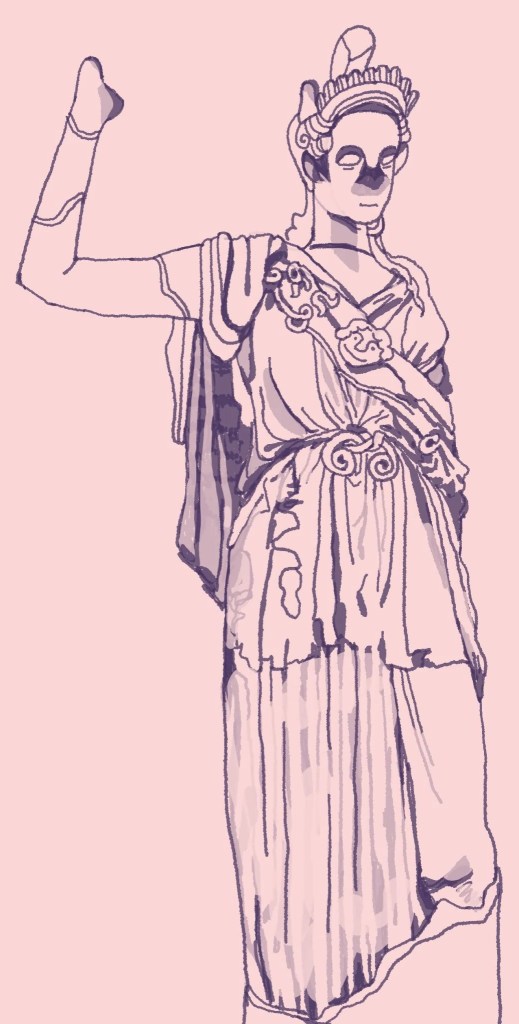
Image courtesy of: RTHWRMS
✷
Hey there everyone! I’m coming at you today with a brief overview of an incredible archaeological find, and what it means in the broader scope of things. This blog is going to be light on the nitty gritty details, but I’m including a download to my academic essay on the topic for anyone that’s interested. If you’re looking for my sources, that’s where you’ll find them.
Without further adieu, let’s get into it!
✷
The ancient city of Palmyra
✷
The city of Palmyra existed within an oasis in the Syrian Desert, at the midpoint between the Euphrates river and the Syrian Coast. This location made Palmyra an influential caravan city, as it was a common stop within trade routes.
✷
At its height, Palmyra attracted a myriad of peoples from as far away as China and Indonesia. It was also not unusual to find other near eastern peoples such as Babylonians, Persians, Jews, Arameans, and Parthians, as well as those from more western civilizations such as Greece and Rome.
✷
It is precisely because of this multiculturalism that the statue I’m about to talk about even exists in the first place. Palmyra’s religion was very syncretic (meaning that elements of differing faiths were often blended together). The statue of Allāt-Athena blended the Arabic goddess Allāt with the Greek goddess Athena. It was a later addition to the temple of Allāt, and eventually replaced the temple’s original idol after it went missing during a Roman attack.
✷
The Statue
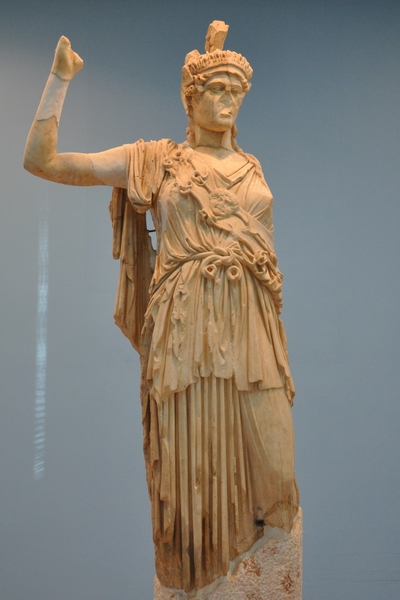
This image, provided by Marco Prins of Livius.org under CC0 1.0 Universal license, depicts the statue before its destruction by terrorist attack on March 16th, 2016.
✷
Though we might not have much by way of written records when it comes to the statue, there is a surprising amount of information that can be gleaned from observation. Firstly, it’s made out of Pentelic marble (from Mount Pentelicus in Attica, Greece), which shows that it was imported to Palmyra, rather than made by local craftsman. The statue is also one of very few imported works found on the site; a fact which suggests particular importance.
✷
Previously, the restored statue stood approximately seven feet high, and would have been slightly more than eight feet tall in antiquity (on account of a now-missing sphinx which would have sat on the top of the goddess’ helmet).
✷
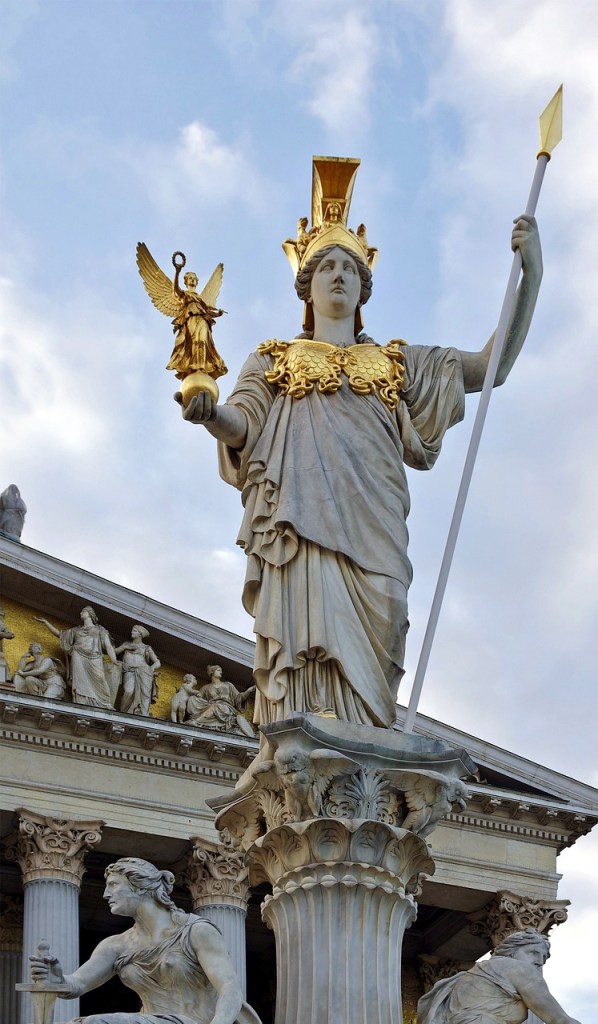
Much of the statue’s face was damaged at the time of discovery. However, enough detail remained for Michał Gawlikowski to determine that it is a copy of the famous Athena Parthenos (pictured right)
✷
That said, there are some key differences between the Allāt-Athena of Palmyra and Athena Parthenos. Archeologists were able to discern that Allāt-Athena’s right arm was originally raised and holding a spear, whilst the left arm held a shield as one typically would in combat.
✷
Allāt-Athena’s girdle consisted of two snakes intertwining, which was a feature not found in most (if any) copies of Athena Parthenos. The aegis (typically a piece of armor associated with Zeus and Athena) also appeared on Allāt-Athena quite a bit differently than it does on Athena Parthenos. Rather than a piece of chest armor, the statue from Palmyra wears the aegis in the form of a sash or belt worn diagonally across the chest and affixed with the head of a gorgon in the center.
✷
These differences create more questions than they answer! One can’t help but wonder if the Palmyran idol was a copy of another lost statue, or if it was commissioned with these changes specifically for the temple of Allāt. If it was commissioned, who did so and why? Was the statue created to win over Hellenic and Hellenistic patrons visiting the temple? Also, how did the people of Palmyra view this syncretic deity?
✷
I could keep asking questions for days, honestly. This statue is fascinating! It also happens to be a really clear example of religious syncretism in the ancient world. We like to think of ancient deities as fitting into clear and concise domains of influence, but the reality is that these spheres of influence shift over distance and time. Just think about it– how often do you find two people with the same understanding of the Christian God? Ancient peoples were just as varied (perhaps even more so, considering that they lacked things like textbooks and the internet).
✷
Next time you learn about any kind of faith, I recommend looking for places you can find examples of syncretism. It’ll give you a better understanding of the building blocks, AND you’ll get to see how different cultures react to the same faith. You’ll see a lot more examples of syncretism as you keep looking!
✷
Are there any examples of syncretism or faith blending that you’ve noticed in your life? What has your experience been with them? I’d love to hear from you!
✷
Before I let you go, I’ve gone ahead and included a download to my original academic essay on the topic in case anyone’s interested. All of my sources for this blog are in the works cited page.
✷
Oh, and here’s the museum of Palmyra’s donation page if you want to help them recover from the attacks which destroyed many artifacts.
✷

 bogprism
Leave a comment