

✷
Preview image by me, featuring the front endpapers from this Book of Hours
✷
Every so often, when I’m looking at historical art and artifacts, I come across something that completely enamors me. It usually happens when I’m not looking for anything in particular, but rather trying to soothe my brain with some non-destructive scrolling. Some of these surprise gems spawn articles, as the topic of this post has.
✷
Today, I want to share some bits of a 14th century Book of Hours from northeast France. You can view the entire manuscript for free on the Walters Art Museum “Ex Libris” database. I’m going to be focusing on a small portion of the manuscript, but it’s richly illuminated and absolutely worth checking out on your own.
✷
I found a lot in this Book of Hours that brought me joy, but one subject in particular had me falling in love with a nameless scribe that’s been dead for hundreds of years.
✷
It was the birds.
✷
The scribe went above and beyond with the sheer volume of marginalia within this manuscript, and birds seem to have been a favorite of theirs. Each creature drawn with a delicate hand, and many of them are even recognizable as specific species. Marginalia are often a window into the imaginations of their scribes, but when it comes to the birds here, it’s clear that the artist spent a lot of time observing the real thing.

✷
Crows, Crows, and more Crows
✷
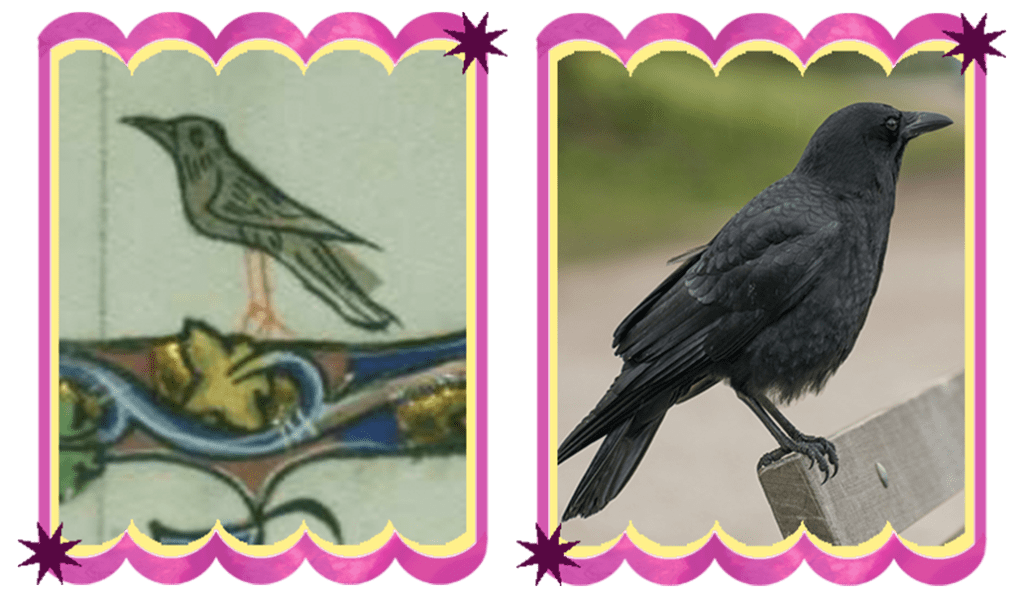
Marginalia of a crow from the Book of Hours, next to a real crow courtesy of Albert Stoynov on Unsplash
✷
Of the many birds in this manuscript, crows stand out as the most numerous specifically identifiable examples. My first instinct was to label them as their larger cousins the ravens, but closer examination shows that all the drawings sport tail feathers that end in a blunted, squared-off shape. Were these ravens, the feathers would end in a point characteristic of the rounded shape they take when fanned out/in flight.
✷

✷
Here’s a small collection of my favorite crows from throughout the manuscript. I really love seeing all their faces– some of them have so much emotion to them.
✷
When it comes to other bird species, there are a handful of identifiable illustrations throughout the manuscript.
✷
So Striking! The European Goldfinch
✷
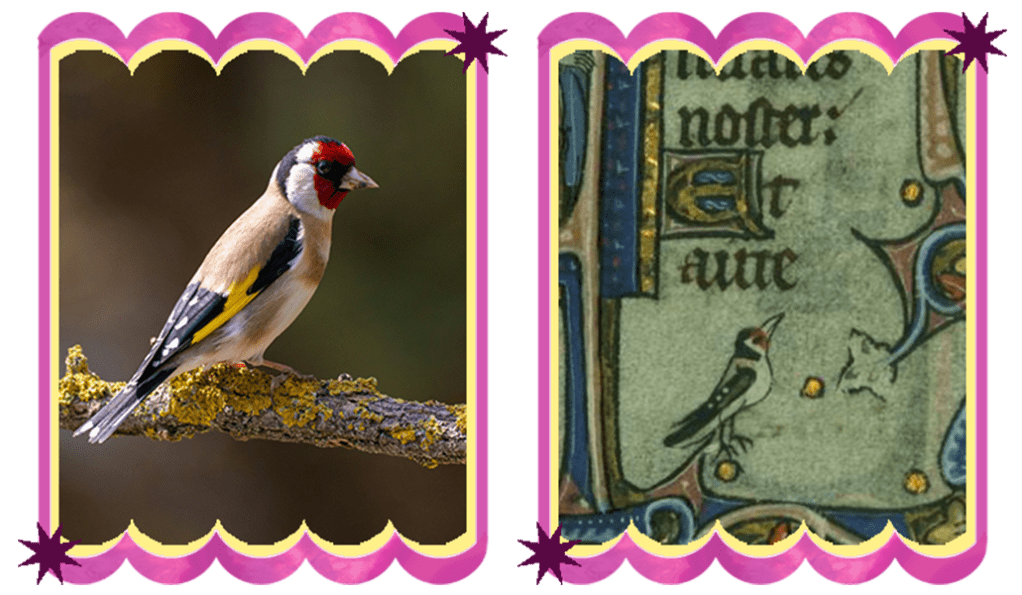
Photo of a real European Goldfinch courtesy of Bóka Balázs on Unsplash, next to marginalia from the Book of Hours
✷
One of my personal favorites from this category is the above example of a European Goldfinch. When I was first trying to identify this one, I incorrectly assumed that it was a woodpecker of some kind. I decided to ask for some help, and the lovely folks over at reddit’s r/whatisthisbird were quick to identify it based off it’s unique facial markings. It’s also a bit difficult to see in the manuscript, but there is a soft touch of brown across the back and shoulders of the bird illumination.
✷
I don’t know why the scribe chose to depict this specific bird, as it appears only once throughout the entire manuscript. Perhaps they had just seen a European Goldfinch and were thinking about it on the day they did this page. Regardless, I love the way it’s drawn, looking to the heavens and puffing its chest out proudly. It’s such a beautiful moment of detail sequestered in a small and seemingly unimportant corner of the page.
✷
A Bird by any Other Name wouldn’t be as Funny
✷
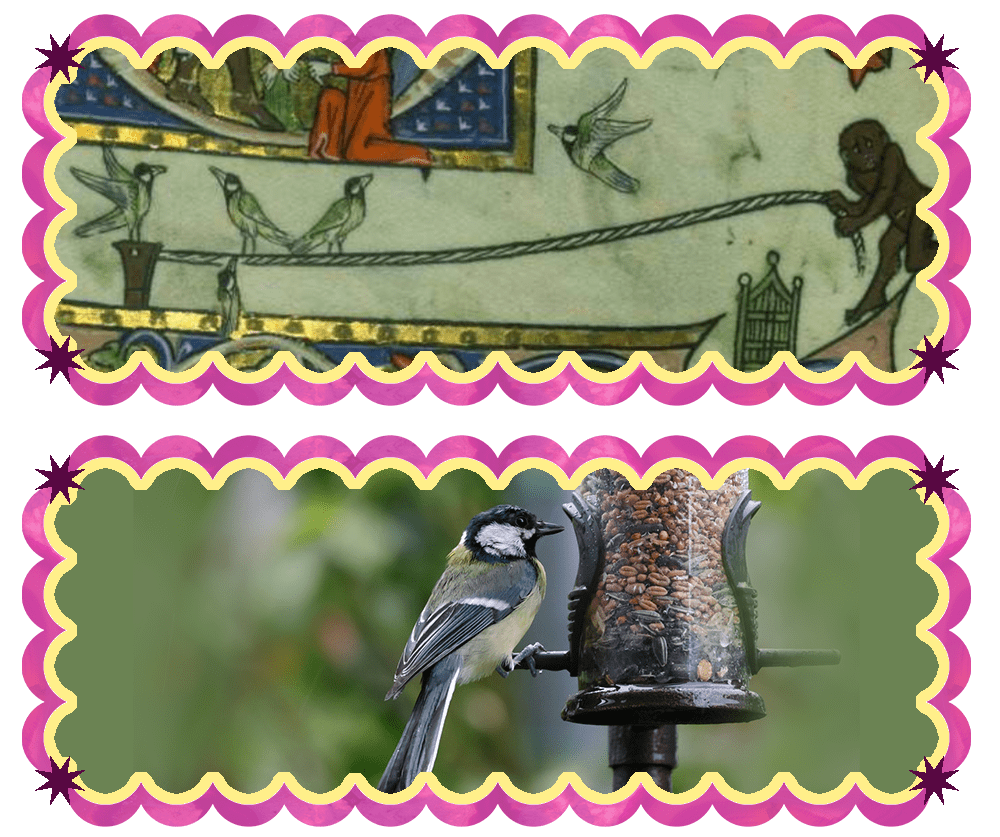
Marginalia from the Book of Hours, above a photo of a Great Tit bird courtesy of Andrey Larionov on Unsplash
✷
I believe that the birds shown in this bit of the manuscript are meant to represent the Great Tit. Like the European Goldfinch, these birds have pretty distinct faces which make them easy to identify. According to Bird Watching HQ, “The Great Tit is one of the most recognizable birds in Europe.” In fact, their current range covers almost all of Europe, so it’s very likely that the manuscript’s scribe would have encountered them frequently.
✷
Bird Watching HQ also tells me that the Great Tit “has over 70 songs and vocalizations.” I can’t help but wonder which of these sounds the scribe might’ve heard. Did their calls play any role in the artist’s inspiration and motivation to depict them here? I also wonder if the songs and vocalizations have changed at all since their time, or if the birds have carried forward the voices of their ancestors.
✷
Like the European Goldfinch, this is the only time that the Great Tit appears throughout the entire manuscript. This bit of marginalia is also unique in its sheer number of birds depicted. I would love to know if the scribe was used to seeing a lot of Great Tits (lol) together like this, or if they were simply having fun drawing/painting them that particular day.
✷
Ye Olde Alarm Clock
✷
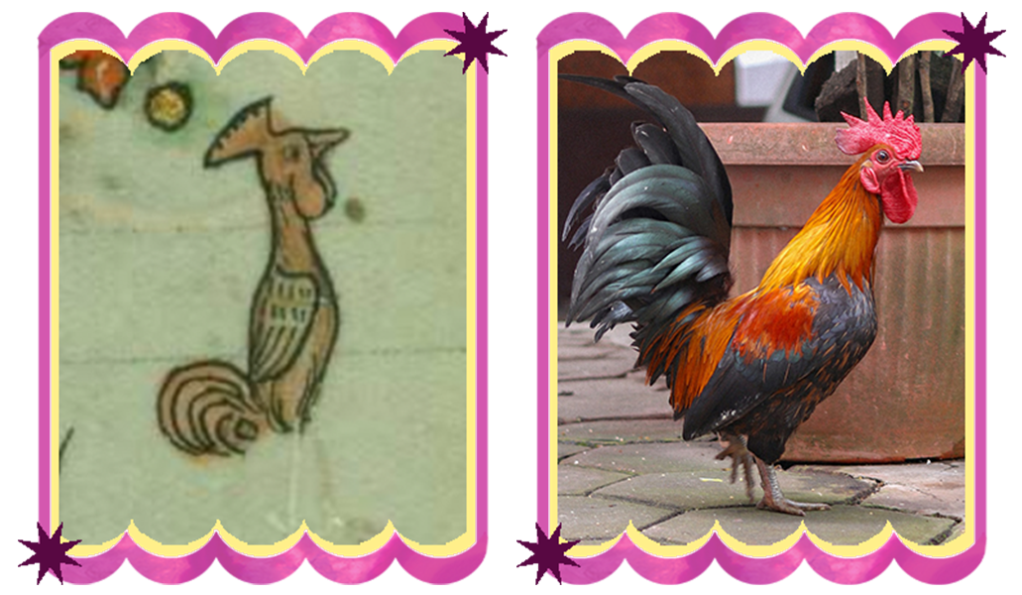
Marginalia from the Book of Hours, next to a photo of a real Rooster courtesy of Livia Widjaja on Unsplash
✷
Perhaps the easiest to identify of the illuminated birds was this Rooster. He’s considerably more stylized than many of the others, sporting a crest shaped like a fan and tail feathers made of semi-circles. It’s also worth noting that the chicken has been drawn without any feet. I wonder if the scribe forgot them.
✷
I think my favorite part of the drawing is the rooster’s face. He just looks so kind and gentle (a temperament my farming experience reminds me is quite rare in roosters). The way he’s standing up so tall also makes me feel like he’s eagerly waiting for something, perhaps the farmer bringing food scraps.
✷
It’s such a tiny drawing, yet it makes me feel so much– even with at least seven centuries between the artist and myself. It makes me feel connected to humanity in a really profound way to know that an unnamed scribe from roughly 24 generations ago in a country I’ve never been to is still able to reach across time and space and make me feel. It’s one of my favorite things that happens when you study art history.
✷
Speaking of Birds with Kind Faces…
✷
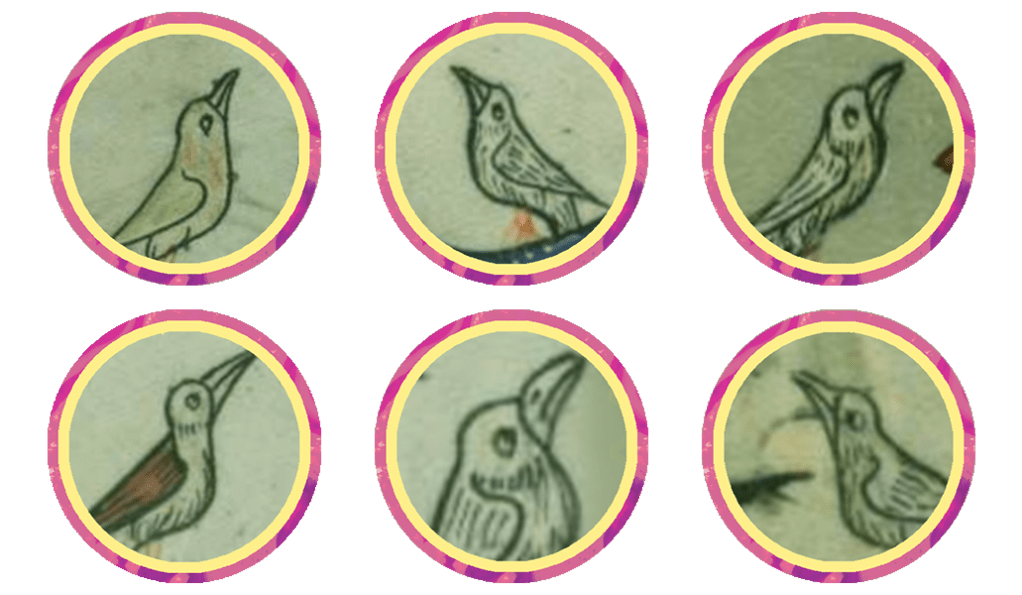
Six of my favorite bird faces, from the Book of Hours
✷
Some of these drawings just have such beautiful expressions on their faces, and I wanted to share a few of my favorites. In my opinion these are the best, but there are many more to be found should you decide to go through the manuscript itself.
✷
One skill that I really admire of this scribe is their ability to infuse life into such small drawings, and with such a delicate hand. I keep coming back to the eye of the bird in the center of the bottom row here. It’s so simple, yet it fits the bird perfectly. It looks contemplative or perhaps curious to me. In contrast, the bird in the bottom right corner almost looks grumpy or petulant. It’s something about the slant of the eye, and the tilt of the head and beak.
✷
…And Faces only a Mother could Love
✷
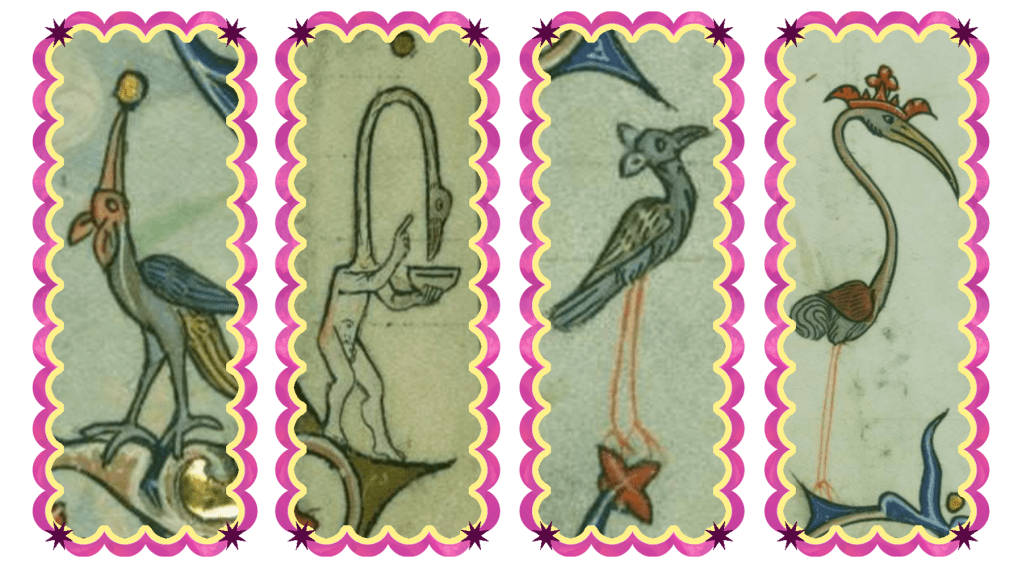
Four manuscript illuminations featuring odd bird-creatures from the Book of Hours
✷
I’d be remiss if I ended this blog without showing you some of the more… creative birds buried in the margins of these pages. This scribe loved drawing realistic birds, but every once in a while you have to try something new. Above are a few of my favorites.
✷
It seems like this scribe had a lot of fun creating birds with long necks, birds with ears, and birds with both of them. Not all of their fantastical creatures have bird-like characteristics, but I’m personally quite fond of the ones that do. They also have a tendency to be rather tall (perhaps a way to increase their strangeness?).
✷
All four of the illustrations I picked to share are wonderfully silly and whimsical, but I’d be lying if I said I didn’t adore one above the rest. As I’m sure may be true with many of you, the second image from the left of the human body with a long bird neck is easily my favorite of the bunch. His pose with his right arm outstretched and pointing at his bird head make it seem as though he might be scolding his head for attempting to drink from the bowl. The bird’s expression also looks a bit annoyed if you zoom in.
✷
I could come up with stories for the remaining three creatures with little effort, too. They all have rather curious details about them, any of which would make decent jumping off points to a narrative. For instance, perhaps the creatures with mammal-like ears live in an environment where sound is especially important. Maybe they have long legs for standing in marshes. The crowned bird all the way on the right could be a king who found out the hard way why he shouldn’t anger the local witch.
✷
For those of you that teach younger kids, this could actually be a really fun activity to try in the classroom! Set them loose with some old manuscripts, and let them pick a bit of marginalia to write a short story about. The Book of Hours I’ve used for this post is a pretty good starting point, though you might want to look through it first to make sure there isn’t anything inappropriate. The Walters Art Museum Ex Libris website also has a ton of other illuminated manuscripts available for free if this one doesn’t work out for you.
✷
In Closing…
✷
There’s a lot of really interesting and fun art that you can find if you go through the online databases of museums and libraries. If you don’t know where to start looking, I have this blog post, and this follow-up post with some links to check out. Be warned, though– if you’re not careful you may just find yourself spending hours composing an article to share some of the fun stuff you’ve found.
✷
Regardless, I hope you’ve enjoyed this slight foray into a little-known manuscript and the birds that captured my heart. Though I will never know their name or story, I consider this my love letter to the scribe of this Book of Hours. Their art captured my imagination, made me want to draw more birds, and reminded me that there’s great beauty to be found in dusty corners.
✷
For a zip file containing screenshots of ALL the birds that appear in the manuscript, see below.
✷
✷
✷


Leave a comment