

✷
Hey there! Welcome to a new series I’m starting called ARTifact Roundup– a place where I talk about a few art pieces and artifacts I’ve found browsing museums’ online collections! The theme will vary from post to post, with this first one being depictions of animals across centuries and cultures. At the end of this post, I’ll also be sharing a Pinterest board with even more finds for you to explore on your own (and don’t worry, everything is properly sourced for all your deep dives!).
✷
Engraved Reindeer Metatarsal from the Magdalenian Civilization
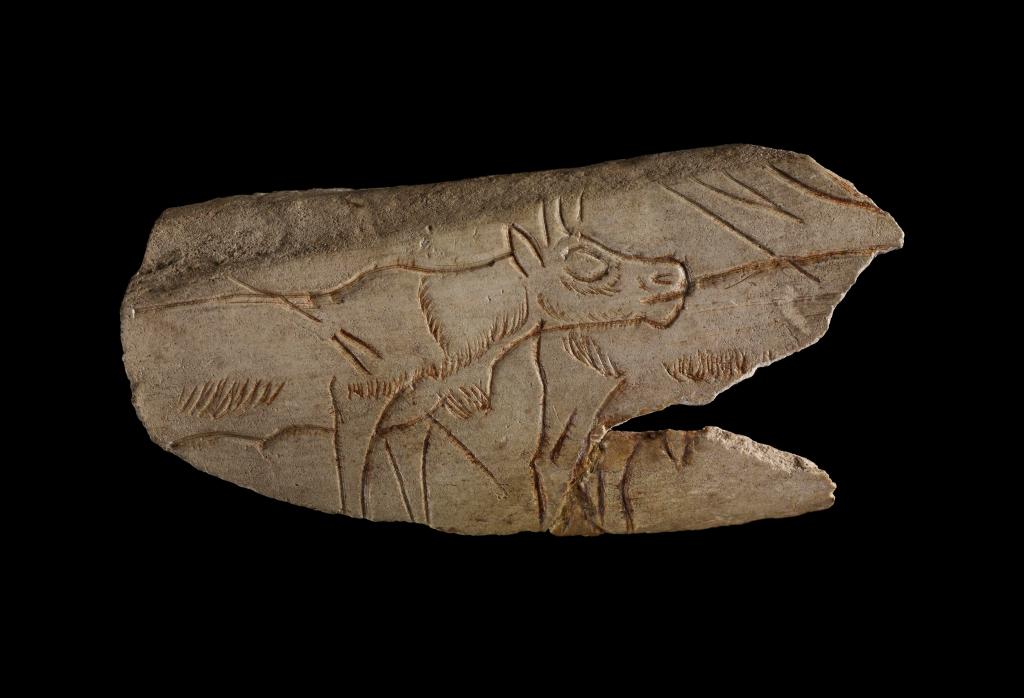
This piece was found at La Madeleine, a prehistoric settlement located on the right bank of the The Vézère River in France. The wider Vézère valley contains over 100 archaeological sites, including the caves at Lascaux!
© The Trustees of the British Museum. Shared under a Creative Commons Attribution-NonCommercial-ShareAlike 4.0 International (CC BY-NC-SA 4.0) licence.
✷
This piece was created sometime during the last phase of the Upper Paleolithic, according to the British Museum’s website. It was excavated by Henry Christy and Edouard Lartet in 1863. When they published their findings, it was under the title “The Age of The Reindeer.” As the name suggests, Christy and Lartet found more than a few reindeer related artifacts.
✷
Though only a fragment, the above artifact is a stunning example of the observation skills of the Magdalenian culture. Carving an image into bone like this would have been incredibly time consuming. I can’t help but wonder what this artist’s first attempts might have looked like!
✷
Fragment of a Tapestry or Wall Hanging from the Upper Rhenish Culture
We just covered something hard, so why don’t we swing over to the other side and cover something soft instead? This textile fragment is Gorgeous.
Originally housed at the Benedictine abbey at Muri, Canton Aargau, Switzerland, this linen and wool fragment depicts a lion-like beast with scaled hindquarters and bird like talons.
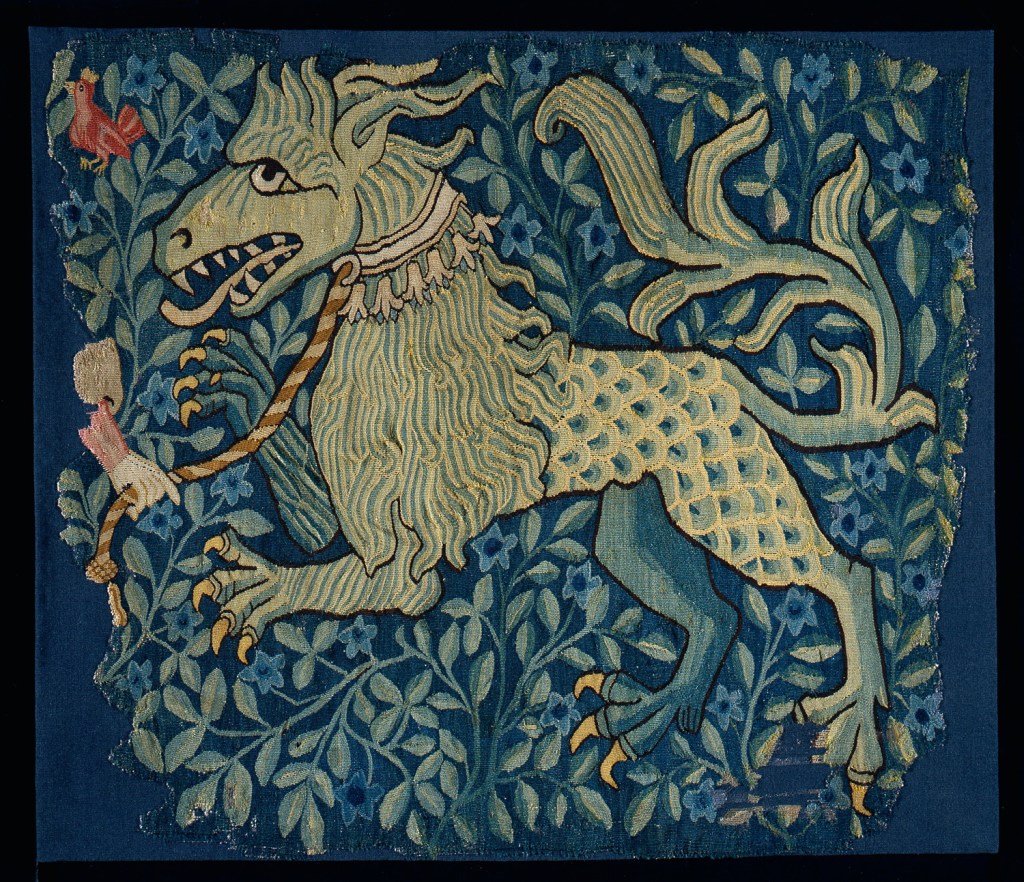
Image provided by the MET as part of their Open Access policy.
✷
The piece was made in Basel, Switzerland sometime between 1420 and 1430 CE by the Upper Rhenish culture. According to the MET’s website, the beast is meant to represent vices which have been tamed (hence the collar and lead on the creature). One can imagine that perhaps the monks at the abbey might have made or commissioned the tapestry to serve as inspiration. During this time period, it was also not uncommon for tapestries to be displayed in buildings for both decoration and insulation.
✷
I absolutely love this piece for the presence it currently exudes and must have even more so before it became fragmentary. Oh, and don’t let the word fragment lead you to believe that this piece of history is at all small. It measures up to a whopping 29 5/8 by 34 1/4 inches, or 75.2 by 87 cm. For reference, that’s a little less than a full yard on either side. For a worse reference point, each side is close to the typical length of a shortsword (30 inches).
✷
The Roman Boar
Last but certainly not least, we have a stunningly naturalistic sculpture of a boar! This one honestly took my breath away when I first saw it.
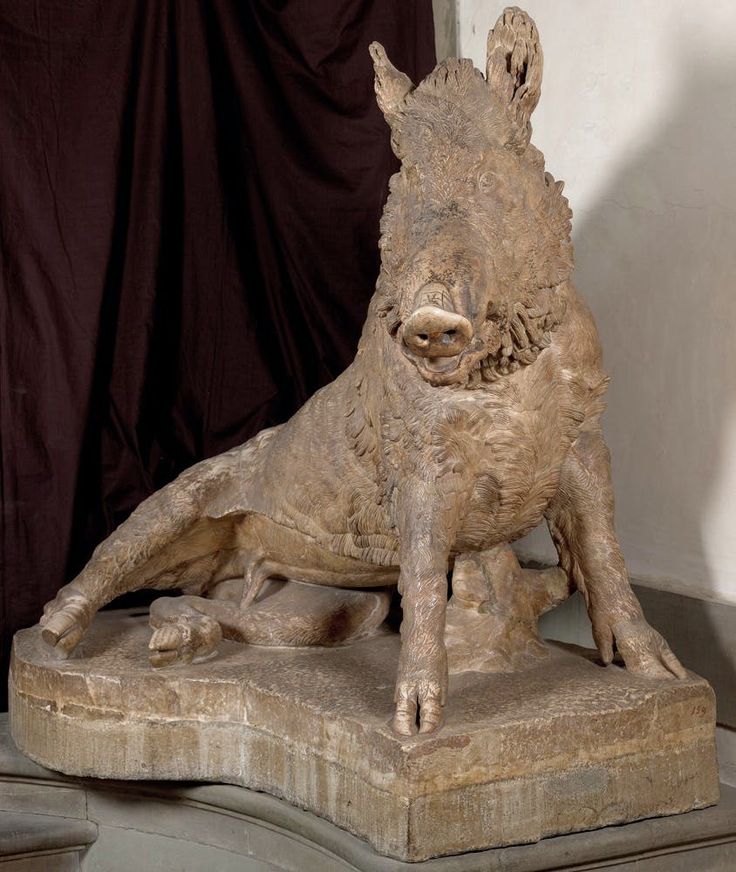
Found in Rome in 1556, this marble statue is inspired by a Greek bronze model. It was made sometime between the first and second centuries BCE.
Image from the Uffizi Museum
✷
According to the Uffizi website, the statue was originally believed to be of ancient Greek origin because of it’s incredible craftsmanship. It’s not hard to see why, either! The boar reclines in a natural pose, appearing to be just about to stand up. Every detail is immaculate, with the main flaw being the tusks that were shortened during a restoration (male boars have longer tusks).
✷
If you’re like me and want to see the statue in all it’s glory, I recommend checking out the link underneath the image! It leads straight to the museum website page with the boar, and includes a rotatable 3D model. I’m honestly so enamored by this depiction that I just might have to try my hand at drawing it!
✷
Want to see more?
I hope you enjoyed reading this blog as much as I enjoyed writing it! So many museums these days have online collections, and they’re such an incredible wealth of information. I’ll be doing blogs like this periodically, so keep an eye out for more inspiration!
✷
Lastly, as promised, here is the link to my Pinterest board with even more historic art featuring animals!

 bogprism
Leave a comment