

Hello and welcome to my very first draw & learn with me! I’m hoping to do this with a number of subjects, and use these blogs as a way to share all the fun stuff I learn. For today, we have a blog about the wonderful dinosaurs belonging to the genus Psittacosaurus. The genus consists of nine to eleven different species, which is actually the most attributed to any non-avian dinosaur! For the purposes of this blog, we’ll be looking at the genus as a whole rather than getting into the nitty gritty of the differences between individual species.
✷
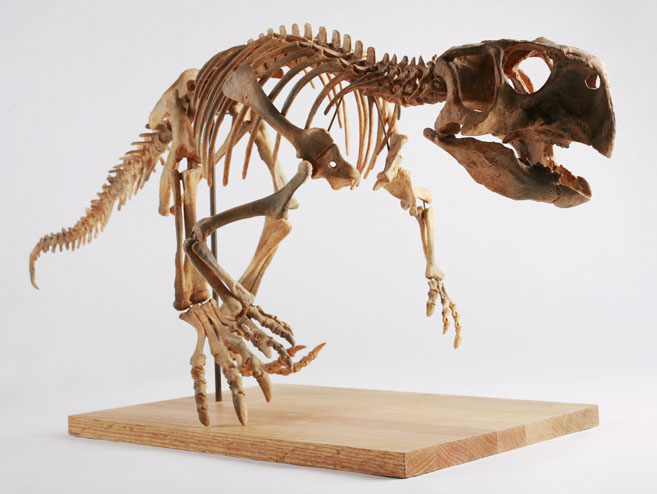
Psittacosaurus Meileyingensis Skeleton Cast
From the Children’s Museum of Indianapolis
✷
Psittacosaurus is one of the earliest ceratopsian (same suborder as triceratops) dinosaurs that we know of. When I first learned this, I was picturing a big triceratops-like dinosaur, complete with a frill and horns. That however is not the case. From beak to tail tip, the largest the Psittacosaurus gets is 6.5 feet. It’s estimated max weight is somewhere over 44lbs.
✷
I got really excited when I realized something I think is very important; Psittacosaurus would have been roughly big dog-sized. In some species, Psittacosaurus was even smaller! Can you imagine having one of these as a pet? I wonder if they would have wagged their tails when excited or happy. The imaginal dinosaur in my brain certainly does.
✷
When I went to draw the Psittacosaurus, I decided to start with a couple of sketches of its skull. Admittedly, I forgot to take any pictures until after I’d moved on to the body. That said, you can see the start of my two skull attempts on the right side of the page. I wasn’t having much luck, especially with the three quarters view that I later erased.
✷
My pencils are a bit light, but hopefully you can make out the aforementioned skull sketches on the side there

✷
The Psittacosaurus skull has an interesting shape, to be sure. It concludes at the tip of a beak, which may have originally been covered in a keratin sheath, similar to some birds today. This beak, combined with specialized self-sharpening teeth would have made it easy for the Psittacosaurus to sheer off the plant material that made up its primary diet. The teeth weren’t made for chewing, though, and we know that this creature utilized gastroliths in the digestion of its food. If you’re unfamiliar, a gastrolith is a swallowed stone that sits in an animal’s digestive system and aids in the breakdown of food.
✷
Perhaps the most striking part of the Psittacosaurus’s head would have been the two bony points extending outwards from its cheek bones. These really give the creature an interesting silhouette, and I can’t help wondering what their primary function might have been. I first assumed that these points were the beginning of the bony neck frills present in later ceratopsians, but the general consensus seems to be that they’re an example of convergent evolution. This means that the cheek points and neck frills evolved independently of one another, despite their similar structure.
✷
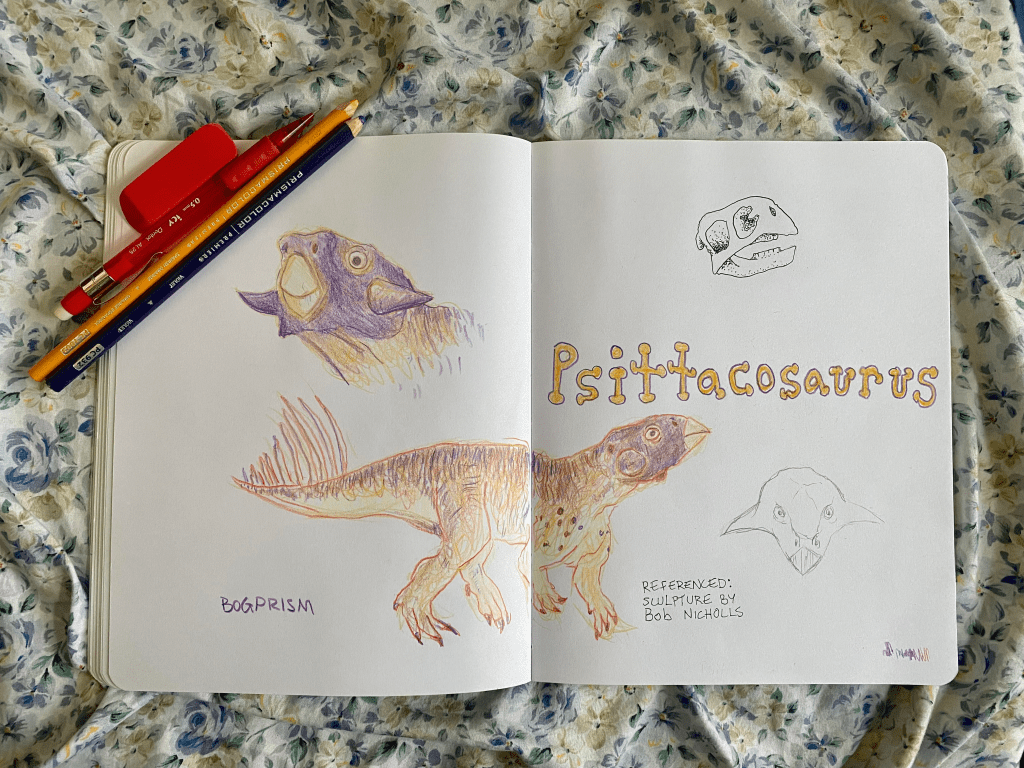
After learning about the skull of the Psittacosaurus, it was time to tackle the body. I got out my colored pencils for this part, and focused on having fun while creating a reasonably accurate depiction. For this stage, I referenced a sculpture by the artist Bob Nicholls. I highly recommend checking it out if you’re at all interested in the Psittacosaurus— it’s one of the most accurate depictions of a dinosaur to date! It even includes countershading, which we know from a remarkable fossil which contained preserved melanosomes and skin impressions. Talk about cool!
✷
My drawing appears more quadrupedal than anything else, so I’m calling it a baby Psittacosaurus. As far as we can tell, this dinosaur was likely quadrupedal in its juvenile state and bipedal in adulthood as the growth of its forelimbs slowed and growth in the hind limbs continued. Then, they would be what we would refer to as an obligate biped.
✷
The last thing I want to touch on before I share my final drawing are the structures we’ve found at the end of the Psittacosaurus’s tail. These bristles were arranged in clusters of three to six bristles at a time, and were filled with pulp. At first, I thought these bristles might be a form of proto-feathers as seen in some other dinosaurs. However, they differ from feathers in that they don’t grow from a follicle and are unbranched. The function of these structures seems to be contested, with one paleontologist even theorizing that they may have been the base of some kind of fin. This theory seems pretty out there, but it’s certainly interesting to ponder!
✷
In any event, I think it’s finally time to share my finished drawing!
✷
✷
I hope you enjoyed this blog and maybe even learned something about this incredible dinosaur! I couldn’t touch on even half of the science out there surrounding the Psittacosaurus, and I highly suggest doing some more research if that’s something that interests you. There were a lot of cool facts that ended up getting cut from this blog so it wasn’t too terribly long, if I’m being honest. Who knows; maybe in the future I’ll revisit this topic and give you a run down of the other information I found fascinating.
✷
What about you? What’s your favorite dinosaur or dinosaur fact? If you don’t have one, what’s your favorite fact from this blog? I’d love to hear from you! Have a lovely rest of your day ❤
✷
 bogprism